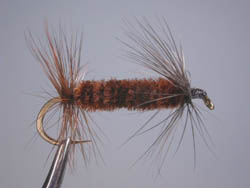
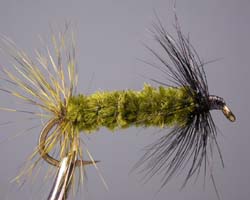
Flies Tied By:
Jim LaFevers
Fly Origination:
Unknown
Recipe By: Jim
Story By: Jim
Jim's Home: Conroe,
Texas
Jim's E-mail:
jimlafevers@yahoo.com |
Jim has been an ardent flytier since 1977. Growing up in
Northwest New Mexico, he was exposed to flyfishing at a very
young age. Though he prefers to tie flies for trout, he also
ties warmwater and saltwater patterns and has been known to
take a flyrod after anything that has fins and swims. |
Having
been raised in Farmington, New Mexico, I had plenty of trout
fishing waters within short distances. The San Juan River
was one of them. In the late seventies when I began to tie
my own flies I frequently headed to the San Juan. This was
before the San Juan grew into such a technical midge river
and prior to the development of the San Juan Worm. Along the
way I would stop at the local fly shop, Jim's Sporting Goods
in Bloomfield, New Mexico to get the latest fishing mis-information.
It is this fly shop that I
believe developed the now famous San Juan Worm. However,
patterns for the San Juan in the late 70's included various
woolly worms, nymphs, standard wets and dry flies. But a
very productive fly that the shop had in their fly bins was
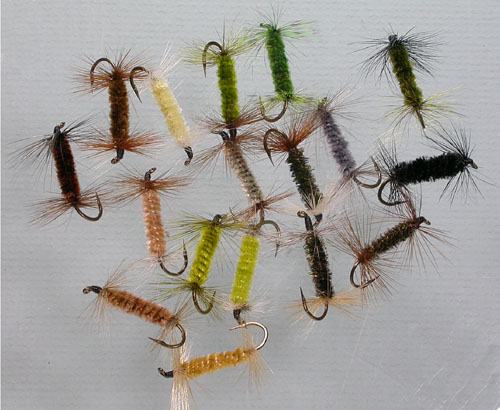
referred to as the "double hackle". Mainly a fore/aft fly
design tied with hackle and chenille. Back then, double
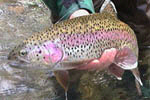
hackle patterns served me well for the browns and rainbows
in the San Juan.
My
fondest memory of fishing the San Juan came one October fall day
in 1978. The cottonwoods were gold and the sky was overcast with
a chilly north wind. I was fishing below the quality water
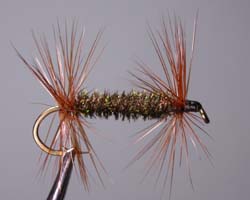
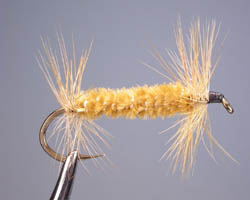
section that day using either a
Double Brown Peacock or a Double Ginger/Ginger (see images
below).
I
would cast slightly upstream and allow the fly to dead drift and
then swing below me, (the chenille body, once waterlogged provided
enough weight to sink the fly). I then would strip it back. Most
strikes occurred either on the swing or as I stripped the fly. Many
rainbows and browns fell to that technique that day.
Since
then, I have tied double hackles in many colors. The pattern is not
limited to trout and rivers, but is successful on warmwater species
and in stillwaters as well. Black/brown
versions can be used as large nymphs, stoneflies, madtoms, crayfish,
sculpin and dragonfly imitations.
Green/olive
versions can represent many nymphs, such as the
damselfly.
Grey
and lighter versions serve as baitfish imitations.
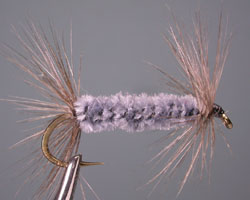
Variations with peacock bodies are almost always
effective. Double hackles can also be fished dry, perhaps as
stonefly or hopper imitations.
The possibilities are endless.
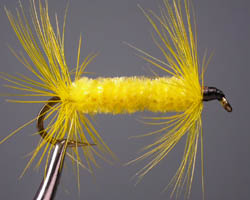
The
double hackles are easy to tie and the materials are readily
available. The fore/aft design can also be incorporated into small
dry flies as the well known Renegade has proven. Give them a try,
you may be pleasantly surprised.
--Jim LaFevers
|