Fly Tied By:
Loren Williams
Story By:
Loren
Home: Port Byron,
NY
E-mail:flyguy95@twcny.rr.com
Web site:
www.flyguysoutfitting.com |
Loren has been fly-fishing since
he was a child--over 25 years ago. Not long after
picking up a fly rod he began to dabble at the vise.
Since those early years in northeastern Pennsylvania he has
developed insane passions for both. He now resides in
Upstate NY, where he guides sports to salmon, trout and
steelhead, and ties flies for commercial and custom
clients. |
I
am, admittedly, a trout enthusiast. I am most at home on a
small stream, toting my 5-weight, seeking the grace and
solitude offered amidst the gurgling and babbling of my
favorite wild trout streams. My blood pumps just a bit more
fervently as my soul soaks in the warmth, and my eyes strain
to decipher the current state of affairs as it relates to
where, and on what, the trout are feeding. But come
September in Upstate New York, a new game comes to town.
From the ninth month of the year
until April I assume the role of a steelhead addict. I don my guide
badge and revel in the joys of assisting new, and veteran, anglers
as they do battle with some very large and powerful fish on very
light and limiting tackle. Since I do not guide full-time, I am able
to spend enough time on the water as an angler to enjoy these
creatures one-on-one.
After a late March trek to
Central Pennsylvania to seek out the BWO hatch on Centre County’s
fabled Spring Creek with some close friends I returned to my Upstate
home eager to check the status of my favorite Lake Ontario
Tributaries. I was met with a deluge of rain while in Pennsylvania
that brought the local streams out of their banks for the first time
in years, and I was anticipating the same for my local streams. Yet
I had to check. It was the first week of April 2002 and the season’s
meager steelhead run was coming to an end. I needed one last
fix.
Located near my home is a small,
unassuming tributary. One of the few remaining tribs that get good
runs without the crowds steelheaders have grown used to. As I parked
my vehicle streamside I was pleased to see the flow, while not
normal, very fishable. The off-color conditions were not ideal but
it appeared worth the effort. With my 8-weight strung I was off on
what would be a radical 5-days of fishing.
What I found in those 5 mornings
are what memories are made of. Fish after glorious fish
fell victim to my tiny egg patterns. A pleasant mix of hungry,
yet somewhat tired drop-backs and chrome-bright, violent fighting
"freshies" kept my senses at full. Over 50 fish came to the bank for
me in those 5 days. But one individual has been imprinted in my
memory.
As the days progressed and the
waters cleared and receded, the numbers of fish dwindled. Gone were
the good numbers of fresh fish, as they bedded, spawned and dropped
back to the lake a short few miles downstream. Suckers began to
invade the stream as they too began their spring spawning ritual.
Suckers, for me, mean a switch from egg patterns to streamers.
Nothing against suckers, but I was after the season’s last
steelhead. Suckers were "suckers" for my high-sticked eggs, and the
current population of "droppies" were hungry as they trekked
downstream. Streamers appeal to them very nicely. I was
armed.
The last morning was pleasant.
Warm air and warming waters were starting to show life. Huge pods of
suckers were visible in the pools that, only a few weeks ago, were
staging grounds for spawning steelies. The pockets and riffs that
had been producing fish after fish were now growing barren. I had
taken a few tired old bucks and was contemplating ending the season.
No new bookings and the thought of rising trout were prominent
factors in that contemplation.
I wanted to probe one last
smallish glide that was a perfect denizen for the few remaining
steelhead. With no one, besides me, on this stream in the last 5
mornings I was confident that I could land one last
fish.
The first drift through the run
was met with a dead-stop midstream. "Hooked up!" I yelled to myself.
Yet another fine droppie was brought bankside and released. Twice
more this occurred—with no wasted casts between. All three of these
fish were spent males. Tired from the spring’s events they made some
nice runs but failed to leap. I figured that by fish #3 I had
exhausted this run; but a few more probing drifts were in
order.
Checking the 6-lb. fluorocarbon
tippet for abrasions and honing the hook on my size 4 White
Doublebunny seemed tedious. Maybe I was procrastinating ending this
season. It had been a tough season. Low water had minimized the runs
in the small tributaries that I prefer. Every high water event
provided a few good days of fishing—but nothing long-lasting. The
natives had been restless most of the season. Still, it had been a
good season. The fish were around, but we had to work harder for
them. From a 38-pound Chinook to a client’s first ever steelhead,
many memories had been made. As I made the last casts of this season
my mind pondered the events of the last seven
months.
Then, on one magical drift my
line stopped. Not a subtle, questionable stop, but a heart-pounding,
solid "BAM." I was hooked up yet again. But this fish was different.
In a flash of silver my target raced downstream at a rate beyond
reason. With rod held high I watched as the backing peeled off my
Harris Solitude. As a last resort, I pinched down on the line and
dropped my rod tip low and to the side. The fish reacted by going
airborne. Leaps, tailwalks and more screaming runs ensued. Over all
the fuss I heard myself laughing. What an ensemble of
noise!
Somehow, I found myself counting
the leaps. One, five, twelve…twenty-five leaps later I slid the fish
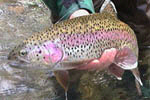
to the bank. I was dust…but this fish shone brighter than the July
sun. Not a sliver of color was to be found on the sleek 6-pound hen.
As I rolled her over to expose her left side I found the mark I
suspected—a left pectoral fin clip. This is the mark of the Skamania
Steelhead, a summer-run variety. They are known for their
acrobatics—and she did not disappoint me.
As I unhooked her and slid her
back into the water I offered a word of thanks. I stood, unstrung my
rod and walked back to the car. My season was done. A fine fish—a
fitting end to a tough season.
--Loren
Williams
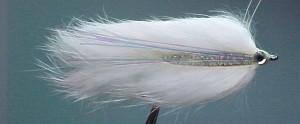
Front-lit image
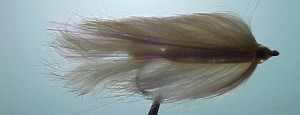
Back-lit image
Hook: Mustad 80400 #4 (This hook is no longer in
production but your favorite 3XL-4XL streamer hook will be just
fine. I prefer straight-eye hooks for my streamers to eliminate
"beaks")
Thread: 6/0 Danville,
white
Weight: .30 lead wire wrapped over middle 2/3 of
shank and coated heavily with thread, tapering the
ends
Body: Pearl
Diamonbraid wrapped over the lead wire
Dorsal and Ventral Wings: White Zonker
Strips
Accent Flash: 4-5 strands of pearl Flashabou cut to
irregular lengths
Eyes: Prismatic Stick-On
Head:
2 coats 5-minute epoxy
Note:
Specific instructions for this recipe are listed below,
after "The Story"
|
Fly Tying
Instructions:
- Mount hook and wrap lead wire around middle 2/3 of hook.
- Cover wire with thread—being sure to taper off the front and
rear ends.
- Attach strip of Diamondbraid behind eye and bind with thread
to rear. Advance thread to a point just behind the rear edge of
the Daimonbraid (on hook shank only).
- Cut an appropriate length of white Zonker strip. Separate the
fur so that the hide only is exposed—leaving about 1 hook gape
excess for the tail. Secure the strip to the top of the hook shank
just behind the Diamondbraid with 4-5 very tight wraps of thread.
- Advance thread to the front of the hook. Wrap the Diamondbraid
forward using tight close wraps. Secure at front and clip excess.
- Pull the remaining Zonker strip forward—pulling tightly.
Secure with thread. Zonker strips compress very well so in order
to build a fuller head, do not be afraid to trap a bunch of fur
during the tie-down process.
- Turn the hook over in the vise—be sure to leave much of the
hook point exposed.
- Cut another appropriate length of white Zonker Strip. Poke the
hook through hide side of the strip, leaving enough to the rear to
match the upper tail. Slide the hide around the bend so it meets
the upper strip. Pull the excess forward tightly and secure at the
front in the same location as the dorsal strip.
- Attach 4-5 strips of pearl Flashabou on each side of the fly
at the front. Clip each piece to a different length.
- Build a broad tapered head and attach stick-on eyes where the
fur, thread and Flashabou meet.
- Coat head with 2 applications of 5-minute epoxy. You may place
a drop of epoxy (or waterproof contact cement) between the tail
sections to hold them together, but this is optional, as the
sections should be short enough that they do not foul on the hook
bend. Keeping them short also reduces short-striking.
|
|