|
Fly By: Alberto
Jimeno
Recipe By: Alberto
Jimeno
Story By: Alberto
Jimeno
Home: Merrimack, NH
E-mail:
peruman99@yahoo.com |
Alberto was born in Santo Domingo, Dominican
Republic, while his family was living there, but grew up in
Lima, Peru. He attended college in the U.S. and now works for
a semiconductor manufacturing firm in Manchester,NH, where you
can find him fishing the Merrimack River during lunch. His
home waters are the rivers and ponds of northern Massachusetts
and southern New Hampshire where he fishes for trout, bass,
and panfish. Alberto started fly fishing and fly tying in the
year 2000. |
I
had been looking forward all week to that Saturday. I had made plans
to wake up early and head out to the Ashuelot river in western New Hampshire, have lunch
riverside and fish until late in the afternoon. This was not to be.
Thursday afternoon, while at work, my friend Matt, who lives in
Houston, called. He was going to be in town for the weekend and
wanted to get together and catch the afternoon Red Sox game on
Saturday. This called for a quick change in plans. I no longer had
Saturday free; I only had a few hours since I had to be in Boston by
3 p.m. to make the Sox game.
Instead of driving out to the
Ashuelot I decided to fish the Nashua river, which is about 10 miles
from my house. Although the Nashua river is generally featureless
(and best fished from a boat or canoe) as it makes its way through
Nashua and Hollis, New Hampshire, there is one spot where it looks
like a freestone river. This spot is relatively easy to wade and
usually gives up some nice black bass and sunfish.
That morning I woke up later than
I wanted, about 9am, and shortly thereafter headed out to the river.
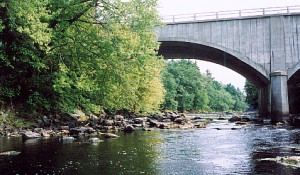
I parked my car in the dirt parking lot next to the Route 111 bridge
and headed down to the river. I started fishing the 2 pools just
downstream of the bridge and caught a few sunfish and chubs. As I
kept working my way downstream through the other riffles and runs I
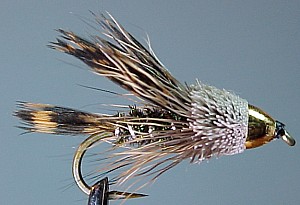
noticed the water was getting deeper so I switched to the Conehead
Muddler this story is about.
By this point, I had reached a
pretty big rock jetty that splits the river in two. The canal of the
left side is shallow and slow moving so I left it alone. The water
on the right side is a different story. It has a small waterfall
with a pool that has some nice structure for fish to live in. In
this pool, the water rushes right up along the far bank of the river
and then flattens out as the river gets deep. This area has always
been productive for me as it holds some nice sunfish and an
occasional 12"-14" black bass.
On my 3rd or
4th cast with the Muddler I felt a strong thump on the
line, set the hook and started to pressure the fish out of the fast
water. As soon as I set the hook I knew this was a different kind of
fish. The headshakes made it feel like a trout, but I knew this was
considered a warm-water fishery and did not get stocked. I could see
it flashing and thought it was a big chub. Once I got it to the
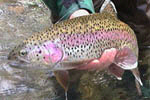
slower water I got a good look at it, and lo and behold it was a
nice, healthy 14" rainbow trout! I landed and released it and took
another cast into the same area. Wham! Another rainbow, this one was
smaller, perhaps 12". This one shook me off once I got it to the
slow water. By this point it was almost 1:30pm and I had to pack up
and put an end to what turned out to be a great day of fishing. The
weather was great, the fish were hungry, and the two unexpected
rainbows were just the icing on the cake.
I relayed the story
to my friend, Peter Frailey. He did some great detective work and
found out the possible origin of these fish. By calling Steve
Wheeler at the New Hampshire Fish and Game, he found that the
downstream feeder brooks do get stocked, but only with brook trout.
But about four miles upstream, in Massachusetts, the Nissitissett
River dumps into the Nashua. This river does get stocked with
rainbows (as well as browns and brookies). According to David S.
Kaplan, author of "The Rivers of Middlesex County", during low water
(absolutely the case during the summer of 2002), trout move
downstream looking for deeper water, and are occasionally caught in
the Nashua River close to the mouth of the Nissi.
Both Peter and I
believe that the two trout I caught somehow made it four miles
downstream from the mouth of the Nissi, through sections of very
slow moving water, countless bait fishermen, and finally settling
into this little pool of fast, well oxygenated water. That was
definitely a good day of fishing.
--Alberto Jimeno
Hook: Mustad
9672 size 10
Bead: small gold
conehead
Thread: 6/0 black
Unithread
Tail: grouse hackle
fibers
Body: peacock herl
Rib:
fine oval silver tinsel
Wing: grouse
hackle fibers
Head: natural deer hair, spun and
trimmed to shape |
|
copyright © Notice by fishingwithflies.com.
All rights reserved. This
material is for your personal enjoyment. Please obtain prior
written permission from the author and fishingwithflies.com
before any other
use. |
|