|
Flytier:
Hermann Schibli
of Manchester, NH and Germany |
|
Although a native of Germany, most
of Hermann's years have been spent in the USA, where he
started fly fishing in Michigan and New Hampshire. Currently
living in Germany, most of his angling is now in Austria,
where he prefers to fish for rainbows, browns, and grayling,
with bamboo and dries. Herm periodically returns to the States
to fish with his American buddies. |
|
Read Hermann's other
stories:
The Serendipity
Hermann's Smuddler |
This fly is a version of the Red Grayling
Attractor, a fly by Walter Reisinger featured recently in a
German fly fishing magazine (Fliegenfischen 1,
Jan/Feb 2005). The original is tied with red thread and has
a long conish head which the author additionally coated with
red lacquer. As the name implies, the fly according to the
author is a great hit with grayling. I thought that with a
few changes it might also be an enticing all-round trout
fly. I changed the thread color to yellow, eliminated the
long pointed head, and trimmed the hackle on the bottom. The
CDC tail and the CDC fibers in the body, I was thinking,
should give it a good floating quality as well as a buggy
look, while it would sit low in the surface film because of
the scud hook and the trimmed hackle. So after tying a few,
I was anxious to try them on one of the Austrian rivers I
fish, the Ager.
The first chance I got to fish the Ager,
armed with my new CDC Attractors (for want of a better
name), the water was high but clear. I was checking out this
long, straight stretch in the dry-fly-only section and saw a
few little rises. This piece of water is notoriously
difficult to fish, because the fish hold fairly close to the
bank (sometimes you can spot them finning above and
alongside the submerged rocks) yet you can't stand in the
middle of the river and fish to shore because the central
current is very strong. So you have to perch on one of the
underwater rocks -- thankfully, many of them are flat enough
to stand on -- and cast either directly downstream or
upstream. I got in the water a little ways above the rises,
cast at an angle downstream and let the fly drift into the
target zone. After the line straightened out, I let the fly
sit below me for a while and then retrieved it. I got a
small trout that way, probably one of the little risers, but
this didn't tell me much about the fly, since dinky kamikaze
trout tend to hit almost anything. However, after a few more
casts a decent rainbow took the fly at the end of the drift,
and later in the evening a heavy fish gulped it during the
drift. I played that fish a while, felt his heft but never
got to see it because the barbless hook somehow pulled free.
I called it a day then, disappointed at having lost a good
fish but feeling very encouraged about these CDC Attractors.
On my second outing to the Ager my
confidence in this fly got an additional boost. I was
walking along the same stretch of the river and saw a couple
of nice rainbows; one of them even rose. This time I got in
below the fish and cast upstream. This wasn't easy because
the high bank on my right made it impossible to cast on that
side, so I had to make backhanded casts over my left
shoulder and also keep clear of a bush hanging out into the
water behind me. After a few attempts I got a nice drift
over the fish yet no takers! But you see, I had come from
another part of the river where I had been fishing a small
deer hair caddis, and now, in my eagerness to get to these
fish, I hadn't changed flies. So I got out one of the CDC
Attractors, tied it on, and on the first proper drift one of
the bows rose up and took it ever so nicely, a fish of about
15 inches. I didn't get the second one -- must have scared
him off -- but I walked downstream, saw another bow, again
about a 15-incher, and got him too by the same method and
with the same fly. These experiments were enough to make me
a believer in the CDC Attractor. I don't know what it
imitates exactly. Because it rides low, it would probably be
best described as an emerger, but it could also pass as a
spent, and we know that trout often take these even when
there aren't any spinners on the water. But no matter. It
looks buggy and I wouldn't hesitate to recommend it for
finicky trout.
--Hermann
Schibli
|
The CDC Attractor |
|
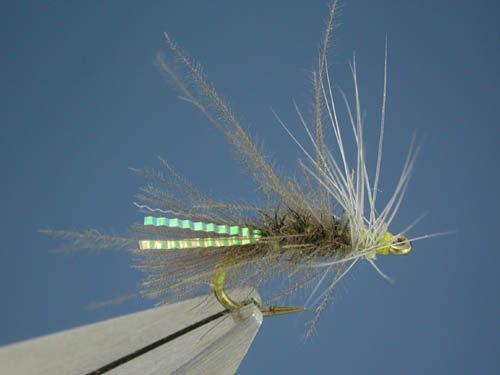
Photo by Peter Frailey
|
Materials and Tying Sequence:
Hook: TMC 2488 size 16
Thread: Yellow 8/0
Tail: CDC tip topped with a few strands
of flat, pearlescent Mylar
Body: One peacock herl entwined with CDC
Hackle: Light dun, trimmed on the bottom
A Few Tying Tips:
Wrap the thread way down into
bend of the hook (this is the part that
penetrates the surface film) and back up to
where the shank begins to be straight. There tie
in the tip of a CDC feather (I use my smallest
CDC feathers for this purpose), only extending
in length half the hook shank, and top it with a
few, say three, strands of flat Mylar or
anything else that's a bit flashy. Tie in one
peacock herl and at the same spot make a small
dubbing loop in which to trap the fibers from
one side of a CDC feather (I use a plastic
office clip). Twirl the peacock herl and dubbing
loop of CDC into a strand and wrap 2/3rds of the
hook, leaving enough room for the hackle. Tie in
the hackle and trim the bottom. Go fishing!
|
|
|